

On this page
Quick Answer
Choosing the right commercial recycling bins starts with understanding how your business generates, collects, and manages recyclable materials.
The most effective solutions are not created by adding more containers, but by selecting recycling bins that match waste streams, user behavior, available space, and collection requirements.
Before selecting a recycling bin, businesses should evaluate where recyclable materials are generated, how users interact with disposal points, and what level of separation is needed. A suitable recycling solution improves sorting accuracy, simplifies servicing, and creates cleaner commercial environments.
Understand Your Recycling Requirements Before Selecting a Bin
The right commercial recycling solution begins with understanding what materials your business actually collects. Before selecting equipment, facility teams should evaluate the waste streams generated in each area, expected volume, and how users interact with disposal points.
Common commercial recycling streams include:
-
Paper and cardboard
-
Bottles and cans
-
Packaging materials
-
Food-related recyclables
-
Mixed recyclable waste
A successful recycling setup does not require a separate container for every possible material. Too many categories can make disposal more complicated and increase servicing requirements.
Instead, businesses should create separation where it improves collection efficiency. For example, offices may require dedicated paper and bottle recycling points, while hospitality or food-service environments may need larger capacity solutions with easier access.
The goal is to create a recycling setup that reflects actual waste generation patterns.
Match Recycling Bin Types to Your Business Needs
Different commercial environments require different recycling solutions. The right choice depends on the type of waste collected, usage frequency, available space, and how users interact with the disposal point.
Offices and Professional Workspaces: Create Clear Recycling Points
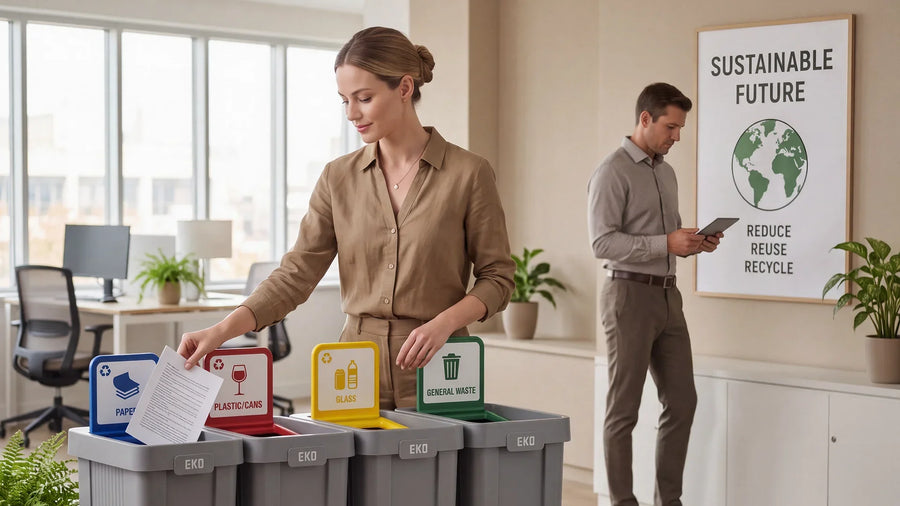
Offices commonly generate paper, beverage containers, and clean packaging throughout the day. Recycling stations should make sorting intuitive while maintaining a consistent workplace appearance.
Key considerations include:
-
Clear separation between streams
-
Convenient placement near shared work areas
-
Easy participation for employees
-
Simple bag changes and cleaning
For a centralized two-stream office station, EKO’s EcoCasa Recycling Bin provides dual inner liners in a space-saving rectangular body. Its foot-operated lid, stay-open function, and wall-fitting design support routine use and servicing in shared office areas.
Corporate Buildings and Public Areas: Combine Durability With Professional Appearance
Reception areas, corporate lobbies, and shared commercial spaces require recycling equipment that supports daily use while fitting naturally into visible environments.
These locations often prioritize:
-
A professional appearance
-
Durable construction
-
Quick, intuitive disposal
-
Easy cleaning and bag replacement
For an integrated two-stream station, EKO's Edison Recycler combines two independent compartments with a full stainless steel body and a flush-to-wall profile. It is well suited to prominent locations where organized sorting and appearance are both important.
For higher-traffic areas that use one container per waste stream, EKO's Urban Slim Open Top Commercial Bin offers fast open-top access, a slim vertical footprint, carrying handles, and a built-in bag fixer. Place clearly labeled units side by side to create an easy-to-use recycling station.
Break Rooms and Employee Areas: Support Convenient Daily Recycling
Break rooms often generate bottles, cans, takeaway packaging, general waste, and food scraps. The setup should make disposal convenient while keeping collection and cleaning manageable.
Important considerations include:
-
Hands-free access
-
Clearly separated streams
-
Enough capacity for peak periods
-
Easy liner removal and cleaning
The EKO Edison Recycler is a practical choice for two-stream collection in larger break rooms because its separate compartments and pedals keep the streams distinct. Where a dedicated food-scrap program is available, add the EKO Deluxe Puro Compost Bin at the food-preparation or cleanup point rather than mixing food scraps with recyclable packaging.
Compact Spaces: Maximize Function Without Increasing Footprint
Smaller workplaces may need to separate waste without using the floor space required by side-by-side containers.
In these areas, priorities often include:
-
A compact footprint
-
Two-stream separation
-
Convenient access
-
Reduced visual clutter
The EKO Vintage Dual Compartment Motion Sensor Trash Can uses stacked compartments to support sorting within a narrow footprint. The upper sensor-operated compartment provides touch-free access, while the lower pull-out drawer creates a dedicated space for bottles or another recyclable stream.
Large Shared Facilities: Increase Capacity Without Losing Separation
Busy staff kitchens, large offices, and shared facilities may require more capacity to reduce collection frequency.
The EKO EcoCasa Plus Dual Recycling Trash Can provides two 40 L compartments, independent pedals, and removable inner liners. It is a suitable option where a high-volume two-stream station is needed and sufficient floor space is available.
Select Recycling Bin Features Based on Your Operational Needs
Choosing a recycling bin involves more than selecting a design. Businesses should consider how the bin will be used, maintained, and integrated into daily operations.
Compartment Configuration
The number of compartments should match the recycling system your business operates.
Single-compartment bins may be suitable for collecting one material stream, while multi-compartment recycling bins can simplify separation by combining different waste categories in one location.
Consider:
-
Local recycling requirements
-
The materials accepted by your waste provider
-
Collection and cleaning procedures
-
User behavior
-
Available floor space
Opening and Operation Style
The way users interact with a bin affects convenience, hygiene, and speed of disposal.
-
Open-top bins support fast disposal in busy corridors and public areas.
-
Step-operated bins provide hands-free access and clear separation through independent pedals.
-
Sensor-operated bins can improve touch-free convenience in premium workplaces and compact employee areas.
Choose the operation style for the location and workflow, not for appearance alone.
Capacity and Collection Frequency
Select capacity according to actual waste volume and servicing schedules rather than automatically choosing the largest bin.
Consider:
-
Number of users
-
Peak disposal periods
-
Collection frequency
-
Space available around the bin
-
The weight and bulk of the material collected
Smaller workplaces may be better served by compact dual-compartment solutions, while larger facilities may need high-capacity bins to reduce overflow and servicing frequency.
Recycling Bin Selection by Business Area
|
Business area
|
Recommended EKO product
|
Approved configuration
|
Why it fits
|
|
Central office recycling point
|
36+24 L
|
Dual liners, foot operation, stay-open lid, and a wall-fitting rectangular design
|
|
|
Corporate lobby or visible shared area
|
30+30 L
|
Full stainless steel construction, two compartments, and a flush-to-wall profile
|
|
|
High-traffic corridor or public area
|
60 L or 90 L per stream
|
Fast open-top disposal, slim footprint, handles, and a built-in bag fixer
|
|
|
Break room
|
30+30 L
|
Independent compartments and pedals support clear two-stream collection
|
|
|
Food-scrap point in a break room
|
7 L
|
Compact dedicated collection for food scraps where composting is supported
|
|
|
Compact office or employee kitchen
|
32+18 L
|
Stacked compartments reduce the floor-space requirement and support touch-free access
|
|
|
Large shared facility
|
40+40 L
|
High-capacity dual compartments with independent pedals and removable liners
|
Frequently Asked Questions
How many recycling streams should a business collect?
Only as many as improve collection efficiency. Too many categories complicate disposal and servicing — offices often need dedicated paper and bottle points, while food-service areas may need larger-capacity solutions with easier access.
Which recycling bin suits a visible corporate space?
A stainless steel dual-compartment unit like the Edison Recycler (30+30 L) pairs organized two-stream sorting with a flush-to-wall professional profile suited to lobbies and prominent shared areas.
How do I choose recycling bin capacity?
Match capacity to the number of users, peak disposal periods, collection frequency, and the bulk of the collected material — compact dual-compartment units for smaller workplaces, 40+40 L stations for large facilities.
Build a Recycling System That Supports Daily Operations
Choosing the right commercial recycling bin requires balancing waste categories, available space, user interaction, and maintenance needs.
EKO Commercial offers a range of approved recycling, step, sensor, open-top, and compost solutions for professional environments, helping businesses create organized and practical disposal points.
Contact EKO Commercial to identify the configuration best suited to your waste streams, space, and collection routine.