

On this page
Quick Answer
Businesses can reduce waste by improving how materials are purchased, used, collected, and measured.
Begin with a waste audit, address preventable waste through better purchasing and reuse, then organize recycling and food waste collection according to each area’s needs.
Clear responsibilities and regular performance reviews help turn individual actions into a sustainable operating system.
Establish a Reliable Waste Baseline
A waste audit establishes a clear baseline by showing what a business discards and where the waste is generated.
Conduct the audit during normal operations and include both customer areas and operational spaces. Sort a representative sample into relevant categories, such as:
-
Paper and cardboard
-
Plastic packaging
-
Bottles and cans
-
Glass
-
Food scraps
-
General waste
-
Unused or expired supplies
Record the approximate weight or volume of each category, its source, and the collection period. Using the same method in future audits will make the results easier to compare. The audit should reveal where materials are being wasted, which recyclable items are entering general waste, and whether current collection points reflect the facility’s actual needs.
Prevent Waste Through Smarter Purchasing
Waste reduction begins before materials enter the facility. Purchasing teams can prevent unnecessary disposal by reviewing order quantities, packaging formats, product durability, and inventory turnover.
Useful purchasing actions include:
-
Ordering according to actual demand
-
Consolidating suitable orders
-
Choosing products with less packaging
-
Selecting packaging accepted by local recycling services
-
Replacing suitable disposable items with reusable alternatives
-
Monitoring expiration dates
-
Rotating older inventory
-
Choosing equipment that can be cleaned and maintained
Purchasing records can also highlight waste that may not be immediately visible. Repeated disposal of unused supplies may indicate excessive ordering, poor inventory control, or limited coordination between departments.
Create a Defined Reuse Process
Reusable materials need a clear destination. Without an organized process, useful items may be discarded or left in storage without being used again.
Businesses can establish designated return points for:
-
Shipping cartons
-
Protective packaging
-
Reusable containers
-
Office supplies
-
Surplus materials
-
Items awaiting repair
-
Equipment that can be reassigned
Employees should know what can be returned, where it belongs, and who is responsible for reviewing it. Suitable items may also qualify for supplier takeback, repair, donation, or specialist recovery programs.
Design Collection Points for Each Business Area
Waste collection should reflect the activities and materials found in each location. A corporate lobby, employee kitchen, busy corridor, and service area should not automatically use the same bin configuration.
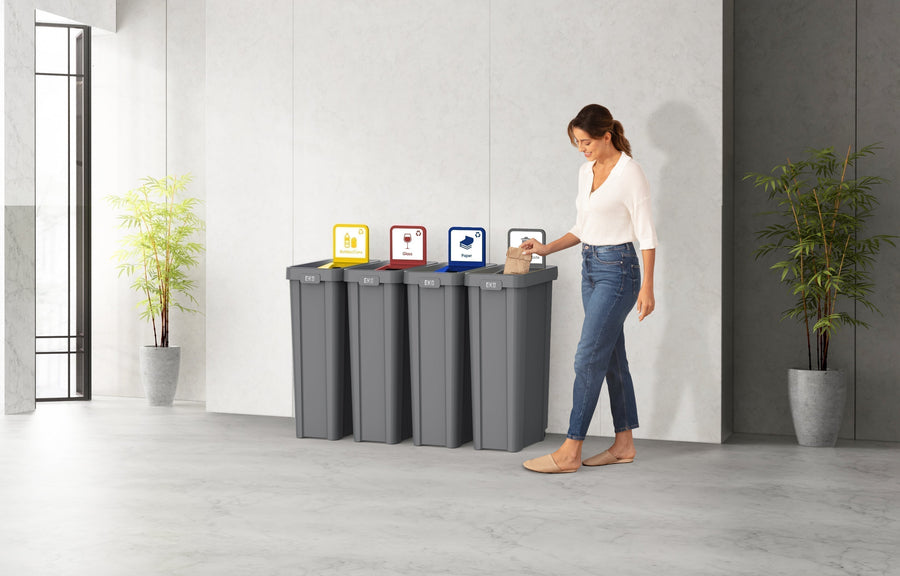
Place recycling and general waste options together wherever practical. This allows users to see the available choices before disposing of an item. Labels should be consistent throughout the facility and should match the materials accepted by the local collection provider.
Capacity should reflect waste volume and servicing frequency. A bin that is too small can overflow during busy periods. A bin that is unnecessarily large can occupy valuable space and make the collection system harder to manage.
Recommended EKO Solutions by Location
| Business area | Recommended product | Configuration | Why it fits |
| Lobby, reception, or corporate common area | EKO Edison Recycler, EK9248 | 30+30 L | Two independent compartments provide organized collection in a professional stainless steel design. |
| Busy corridor or public area | EKO Urban Slim Open Top Commercial Bin, EK9057 | 60 L or 90 L | The slim profile and wide opening support quick disposal in frequently used areas. Multiple labeled units can be assigned to separate streams. |
| Back of house or large shared facility | EKO EcoCasa Plus Dual Recycling Trash Can, EK9135 | 40+40 L | Two large compartments support higher volumes and reduce servicing frequency. |
| Compact office or employee kitchen | EKO Vintage Dual Compartment Motion Sensor Trash Can, EK9336 | 32+18 L | Stacked compartments provide two stream collection while using less floor width. |
| Food preparation or cleanup point | EKO Deluxe Puro Compost Bin, EK9008 | 7 L | The compact capacity supports dedicated food scrap collection where composting services are available. |
Product selection should be supported by appropriate labels, placement, employee guidance, and collection procedures.
Manage, Monitor, and Improve the System
A waste reduction program requires clear ownership and regular review. Purchasing teams can monitor order quantities, packaging, and unused inventory. Facility teams can manage collection points, adjust servicing schedules, and check for overflow, odors, leaks, contamination, damaged liners, blocked openings, and unclear labels. Department managers can identify avoidable waste within their operations, while employees follow the relevant sorting and reuse procedures.
Servicing frequency should reflect the type and volume of waste collected. Food, liquids, and hygiene sensitive materials may require frequent attention. Clean, dry materials can often be monitored and emptied according to fill level, helping reduce unnecessary liner changes and cleaning work.
Businesses should track a focused set of indicators, such as total waste, recycling and composting volumes, contamination, liner consumption, collection frequency, overflow incidents, and unused inventory. Review the results over comparable operating periods. If progress is limited, examine bin placement, capacity, labels, employee guidance, purchasing practices, and servicing routines.
Clear responsibility and consistent measurement help businesses identify problems early and improve the system as operational needs change.
Frequently Asked Questions
How does a business start reducing waste?
Begin with a waste audit during normal operations to establish a baseline: sort a representative sample into categories, record approximate weights and sources, and identify recyclable items entering general waste.
How can purchasing decisions reduce waste?
Order to actual demand, consolidate suitable orders, choose products with less packaging, prefer packaging accepted by local recycling services, replace suitable disposables with reusables, and monitor expiration dates and inventory rotation.
What metrics show a waste reduction program is working?
Track total waste, recycling and composting volumes, contamination, liner consumption, collection frequency, overflow incidents, and unused inventory across comparable operating periods.
Make Waste Reduction Part of Daily Operations
A commercial waste program should connect purchasing, reuse, collection, servicing, and accountability.
When each part has a defined process, businesses can reduce unnecessary disposal and manage remaining materials more effectively.
Explore EKO Commercial waste and recycling solutions, or request a quote to create a durable collection system suited to your facility and operational requirements.