

On this page
Two Waste Programs Under One Roof
A hotel's waste program is really two separate programs sharing a name. Front-of-house — lobby, elevator landings, guest corridors, pool deck — is judged on appearance first and capacity second; a can that looks out of place undermines the same design investment that went into the furniture around it. Back-of-house — kitchen, loading dock, housekeeping closets — is judged on throughput first and appearance not at all; a can that can't keep up with volume between pickups creates a bottleneck that shows up as overflow, which is its own guest-facing problem if it happens in a corridor rather than a closet. Designing both zones from the same product line, rather than treating them as unrelated purchases, keeps the program coherent and the fleet standardized.
Front-of-House: Open-Tops for Public Areas
Public-area cans need to disappear into the design while still handling foot traffic that a back-office can never sees. The Urban family covers this role across three profiles — Round, Semi-Round, and Slim — and a wide capacity range from 56L (Eternal, 14.7 Gal) up to 120L (32 Gal) for the Urban Round in high-traffic lobbies. All are stainless steel, available in natural, matte black, and black stainless finishes, which matters for lobby installations where the can sits next to polished fixtures and needs to read as intentional rather than utilitarian.
Capacity planning for these zones should follow foot traffic, not floor area: a 60L Urban Semi-Round is generally sufficient for elevator landings and guest corridors, while lobby entrances, pool decks, and other high-dwell public zones warrant the 90–120L range to avoid mid-shift overflow. Open-top design (no lid) is deliberate here — it speeds up guest disposal in high-traffic zones where a lid or step mechanism would create a bottleneck, at the cost of visible contents, which is an acceptable trade in most public-area placements but not in fine-dining or high-end lobby settings where a step or sensor can may be preferred instead.
Back-of-House: Built for Throughput
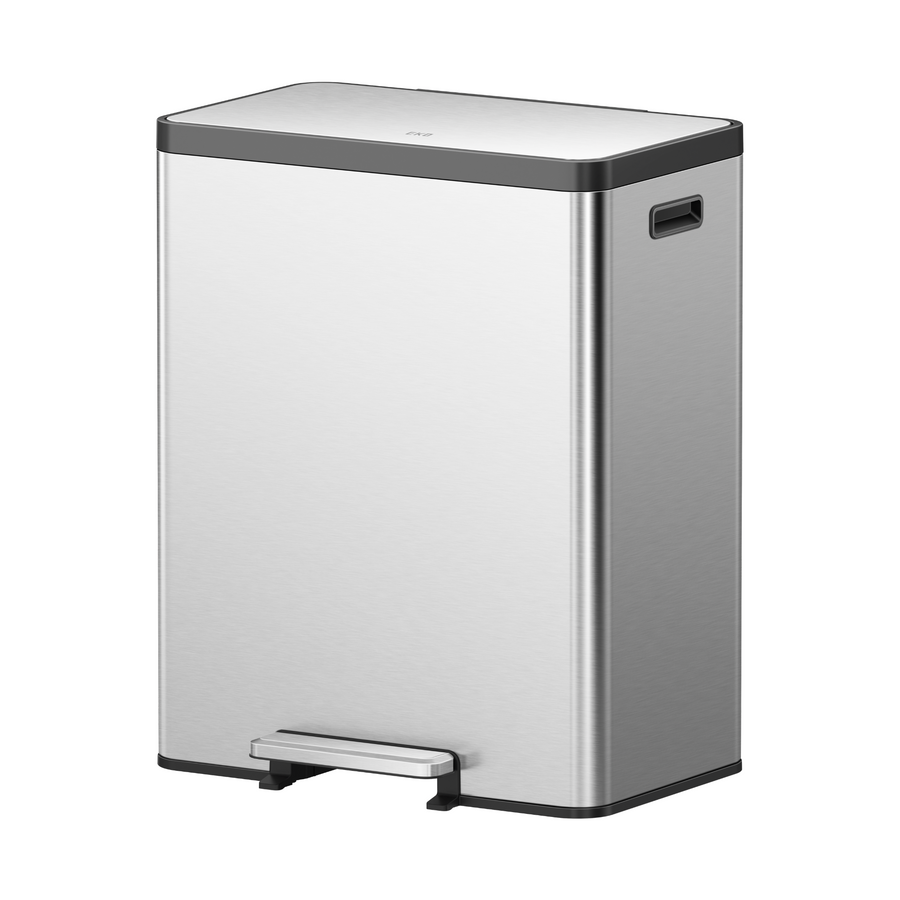
Kitchens, service corridors, and housekeeping areas need step cans built for constant liner changes and heavy fill weight, not aesthetics. Hudson (50L and 75L, with a dedicated bag storage compartment built into the base) and Maxwell (50L, foot-pedal) are the workhorses here — the Hudson's bag compartment specifically addresses the back-of-house problem of running out of liners mid-shift by keeping a stock inside the unit itself. For kitchens running separate waste and recycling streams, the Edison dual-compartment can (30L+30L, or 8+8 Gal) and EcoCasa Plus (40L+40L) handle both in one footprint rather than requiring two separate units.
Back-of-house cans should be sized to the pickup schedule, not the other way around: a kitchen on an hourly bus schedule can run smaller, more frequent-change cans, while a loading dock or banquet kitchen with sporadic staffing coverage needs the larger 75L+ capacity to avoid overflow between checks.
Front-of-House vs. Back-of-House: Design Priorities
| Factor | Front-of-House | Back-of-House |
|---|---|---|
| Primary requirement | Appearance, finish match | Throughput, liner capacity |
| Typical models | Urban Round/Semi-Round/Slim, Eternal | Hudson, Maxwell, Edison, EcoCasa Plus |
| Typical capacity | 56–120L based on traffic zone | 50–75L, sized to pickup schedule |
| Lid style | Open-top (speed) or step/sensor (formal areas) | Step with liner storage |
| Finish priority | Matched to lobby/corridor fixtures | Durability over finish |
Zone-by-Zone Capacity Planning
- Lobby entrance / high-dwell public zones: 90–120L open-top, finish-matched to the space.
- Elevator landings / guest corridors: 56–60L open-top or slim profile, lower dwell time justifies smaller capacity.
- Pool deck / outdoor public areas: 60–90L, stainless or black stainless for weather exposure.
- Banquet kitchen / high-volume back-of-house: 75L step can with liner storage, or dual-compartment for separated waste streams.
- Housekeeping closets / service corridors: 50L step can, standard liner storage sufficient for scheduled pickups.
Browse the full range to compare finishes and capacities across both zones, and pair every can with the correct liner using the bag sizing guide once models are finalized. For portfolio-wide rollouts spanning multiple properties, a quote request is the fastest way to lock in consistent pricing and finish availability across every location.
Keeping the Program Coherent Across Properties
The biggest planning mistake in hospitality waste programs is not under- or over-sizing a single can — it's letting front-of-house and back-of-house purchasing happen independently across properties, which produces a fleet with no consistent finish, no consistent liner code, and no volume-pricing leverage. Standardizing on a small set of models per zone type, replicated across every property in the portfolio, is what turns waste equipment from a recurring one-off purchase into a manageable line item.
Guest Floor Corridors and Room Service: The In-Between Zone
Guest floor corridors and room-service pickup points sit between the two extremes described above — visible enough that finish still matters, but lower-traffic than a lobby, so oversized capacity is wasted budget. A slim-profile Urban can in the 56–60L range is usually the right fit here: narrow enough to sit against a corridor wall without obstructing housekeeping carts, and sized for the lower, steadier volume of a guest floor rather than a public entrance. Housekeeping staging closets one level back from the corridor itself are effectively back-of-house and should follow the throughput-first sizing logic instead, typically a 50L step can matched to the housekeeping cart turnover schedule.
Recycling in Hospitality Settings
Hospitality waste programs increasingly need a recycling stream in both zones, not just back-of-house. Front-of-house dual-stream collection near elevator landings or business centers can use the same Urban profile philosophy with a paired recycling unit, while back-of-house benefits more directly from the dual-compartment options built for volume — EcoCasa Plus (40L+40L) in banquet kitchens, or the smaller EcoCasa and Essential dual-compartment cans (20L+20L up to 30L+30L) in service corridors and staff break areas. Keeping recycling capacity proportional to general waste capacity in each zone, rather than adding an undersized recycling bin as an afterthought, is what keeps a hospitality recycling program actually functional rather than symbolic.
Seasonal and Event-Driven Capacity Swings
Hotels and event-adjacent properties see waste volume spike predictably around banquets, conferences, and peak season occupancy, and a program sized only for average-day traffic will overflow during these windows. Rather than over-sizing every can fleet-wide to cover the peak, many properties keep a small reserve of larger-capacity units (90–120L open-tops, 75L back-of-house step cans) that get deployed to banquet corridors and overflow zones only during high-occupancy periods, then returned to storage. This keeps day-to-day capacity matched to normal traffic while still covering the predictable spikes without an emergency order.