

On this page
Preview Summary
A practical guide to choosing slim trash cans for narrow commercial spaces, including corridors, elevator lobbies, small storefronts, offices, and restrooms. Learn how to compare width, depth, capacity, and lid clearance to find a bin that fits the available footprint without creating unnecessary servicing work. This guide explains when shallow open-top cans work best in public areas, when narrow step cans suit retail and staff spaces, and when compact sensor bins are more appropriate for restrooms. It also covers how foot traffic, waste volume, accessibility, and cleaning routines should influence product selection. Use the recommendations and comparison table to match EKO commercial waste solutions to your layout and operational needs rather than choosing a bin based on appearance alone.
Quick Answers
Narrow corridors and elevator lobbies: Consider a shallow-profile open-top can that fits along a wall without reducing required circulation space.
Small storefronts: A 50–60L slim can can provide useful capacity while preserving floor space near checkout areas and entrances.
Tight restroom layouts: A compact 10L slim sensor can can fit beside a vanity or toilet, with the bin's orientation and lid design determining how much space it needs.
Limited width: Compare actual width and depth. A narrow-width model may still extend farther into the room.
Frequent overflow: Choose capacity based on traffic and servicing frequency rather than selecting the smallest possible bin simply to save space.
Why Slim Trash Cans Work in Small Commercial Spaces
A standard trash can can project into a corridor, compete with retail floor space, or block a narrow gap beside a restroom fixture. But choosing the smallest bin is not always the answer: it may fill too quickly and require more frequent emptying.
The key is to match footprint to available space and capacity to actual waste volume. The U.S. EPA's guide to waste management in commercial buildings recommends understanding waste quantity and composition when planning a commercial waste system.
Slim cans also differ in shape. Some are narrow from side to side; others are shallow from front to back. Lid movement, bag changes, and cleaning access further affect whether a bin genuinely fits.
Hallways and Elevator Lobbies: Save Space Without Blocking Circulation
Corridors and elevator lobbies need convenient waste disposal, but a bin must not obstruct walking routes, doorways, or elevator access. These areas may collect cups, packaging, and general waste from employees, visitors, and passing foot traffic.
For these locations, a shallow-profile, higher-capacity open-top can can provide quick disposal without an extra lid-opening action.
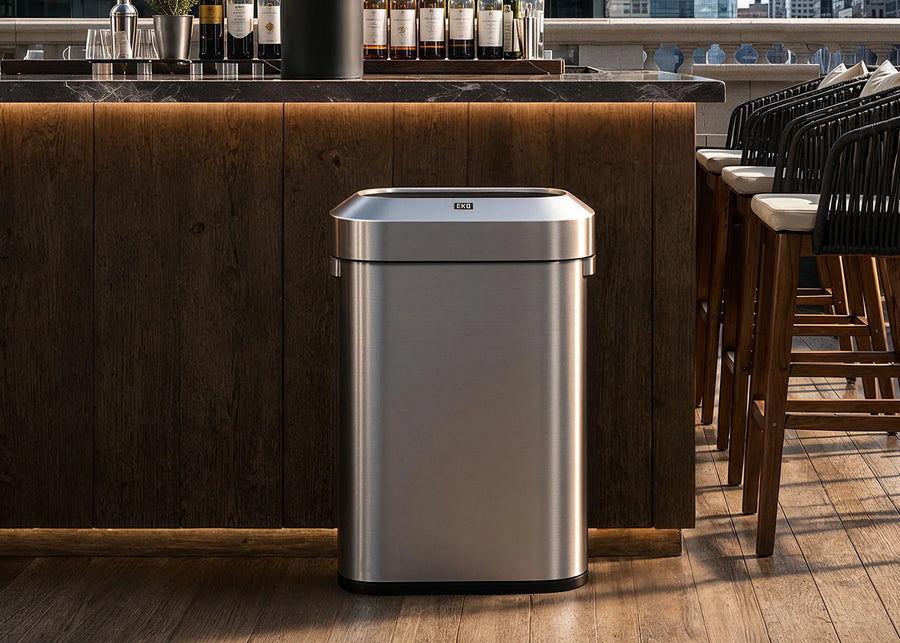
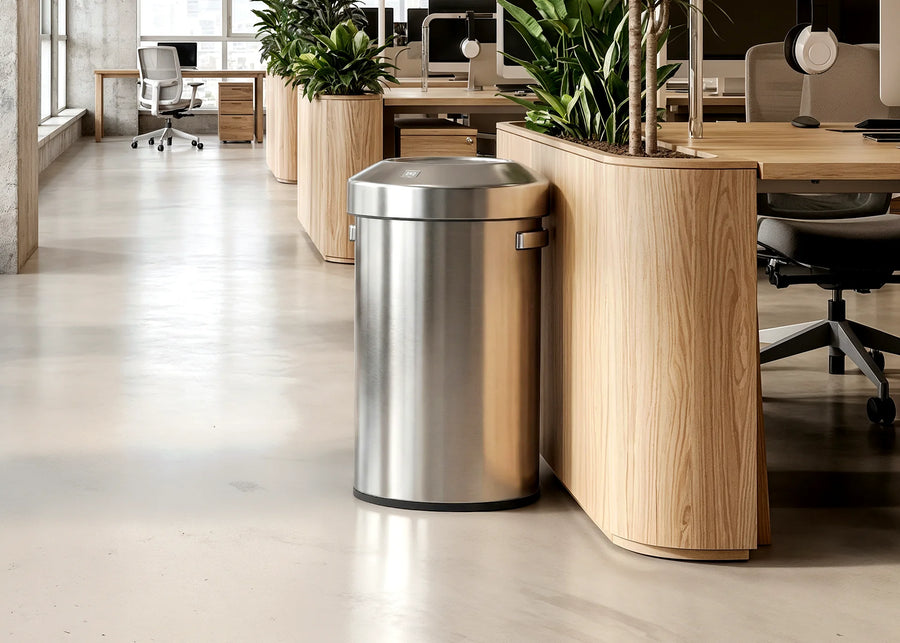
EKO's Urban Slim Open Top Commercial Can offers a 60L option measuring 18.2" W × 11.6" D × 25.6" H. Its shallow front-to-back profile suits spaces where depth is the main constraint, including selected corridors, lobbies, and shared areas. The 90L version measures 20.6" W × 12.6" D × 30.4" H for locations that need more capacity and have sufficient width.
Placement is just as important as product dimensions. The U.S. Access Board's ADA guidance on accessible routes generally requires a minimum 36-inch clear width along accessible routes, subject to specific exceptions. Confirm the actual layout and applicable building requirements before placing a bin in a corridor or elevator lobby.
Small Storefronts and Retail Spaces: Balance Capacity and Selling Space
Small shops need waste disposal near checkout counters, entrances, or staff work areas, but floor space is also needed for displays, merchandise, and customer movement. A low-capacity bin may fill quickly during busy periods, while a bulky unit can take up valuable retail space.
The best choice depends on which dimension is restricted.
If the shop has enough width but limited depth, the Urban Slim 60L Open Top Can offers a relatively shallow footprint and immediate access for cups, wrappers, and packaging.
If width is the main constraint and there is more room in front of the bin, the Hudson Slim 50L Step Can measures 9.8" W × 18.7" D × 24.6" H. Its pedal operation keeps the lid closed between uses, making it suitable for staff areas or retail spaces where covered disposal is preferred.
Do not choose between these models based on capacity alone. The Urban Slim is shallower, while the Hudson Slim is narrower. The available footprint and preferred opening style should determine which works better.
Very Narrow Gaps and Compact Restrooms: Check the Bin's Orientation
Restrooms and other compact areas often have limited gaps beside vanities, toilets, and doors. Here, a few inches can determine whether a bin fits.
EKO offers two 10L slim sensor cans with different proportions:
-
The Astro Slim Sensor Can measures 5.91" W × 10.94" D × 13.5" H. Its extremely narrow width suits spaces where side-to-side clearance is limited. Its inward-opening butterfly lid also reduces the overhead clearance needed.
-
The Morandi Slim Sensor Can measures 11.8" W × 5.9" D × 13" H. Its shallow depth makes it worth considering when the gap between the bin and a wall or fixture is especially tight.
Both provide compact touchless disposal, but neither is automatically the better fit. Measure the gap in the direction the bin will actually sit, and allow enough room to access the lid and replace the liner.
For other commercial restroom applications, EKO's Restroom & Bathroom collection includes compact options for different layouts.
Limited Lid Clearance: Choose the Opening Mechanism Carefully
Some spaces have enough floor area for a bin but not enough overhead clearance for a conventional lid. This can happen beneath counters, beside fixed shelving, or near other fixtures.
The X-Wing Slim 50L Step Can measures 10.7" W × 19.7" D × 24.8" H. Its dual-wing lid opens from the center, reducing the overhead clearance required compared with a conventional single lid. The pedal also allows hands-free operation while keeping waste covered between uses.
However, the X-Wing is deeper than the Hudson Slim. It is worth considering when lid clearance is the main issue, not when the available front-to-back depth is extremely limited. Check the lid's full movement and the space needed to remove the liner before choosing a model.
How to Choose the Right Slim Trash Can
Before purchasing, check four things:
-
Available dimensions: Measure width, depth, and height, including space needed for lid movement, access, and bag changes.
-
Waste volume: Consider what is discarded, how quickly the bin fills, and whether use increases during peak periods.
-
Opening style: Open-top cans provide immediate access; step cans keep waste covered while allowing pedal operation; sensor cans provide touchless access where appropriate.
-
Maintenance and placement: Confirm that the bin can be cleaned and serviced without obstructing circulation, doors, fixtures, or nearby work areas.
The EPA's commercial waste management guide explains how understanding waste quantity and composition helps organizations plan suitable collection systems. A slim design is successful only if it saves space without creating capacity, access, or maintenance problems.
Slim Trash Can Solutions at a Glance
| Commercial Application | Recommended EKO Solution | Capacity | Main Consideration |
| Corridors and elevator lobbies | Urban Slim Open Top Can | 60L / 90L | Shallow profile and quick disposal; preserve clear circulation |
| Small storefronts and checkout areas | Urban Slim Open Top Can | 60L / 90L | Higher capacity without a deep front-to-back footprint |
| Narrow-width retail or staff areas | Hudson Slim Step Can | 50L | Narrow width and covered, pedal-operated access |
| Tight spaces with limited lid clearance | X-Wing Slim Step Can | 50L | Dual-wing lid and hands-free operation |
| Very narrow gaps beside restroom fixtures | Astro Slim Sensor Can | 10L | Extremely narrow width and inward-opening lid |
| Shallow restroom gaps | Morandi Slim Sensor Can | 10L | Shallow front-to-back depth |
Choose a slim trash can based on your available space, expected waste volume, and collection frequency.
Find the Right Slim Waste Solution
Explore EKO's commercial waste solutions to compare capacities, dimensions, and opening styles. For more tailored recommendations, use Find Your Solution to narrow options based on your available space, application, and operational needs.