

On this page
Recycling programs in commercial buildings fail for predictable reasons: bins that don't match the streams staff actually generate, signage that assumes people will read the fine print, and receptacles placed somewhere inconvenient enough that the nearest general trash can absorbs everything instead. Setting up a station that actually gets used correctly comes down to picking the right compartment configuration, labeling it clearly, and placing it where the waste is generated.
Why Stream Separation Fails Without Design
A single-stream recycling bin next to a single-stream trash can only works if people consistently sort correctly, and in practice they don't — contamination rates in poorly designed office and food-service recycling programs run high enough that many buildings are quietly landfilling "recycled" material after the fact. Dual and multi-compartment cans solve this by making the correct choice the easy choice: one physical unit with clearly divided compartments, so sorting happens at the point of disposal rather than relying on two separate cans that are easy to mix up or place apart.
Two-Stream vs Multi-Stream Setups
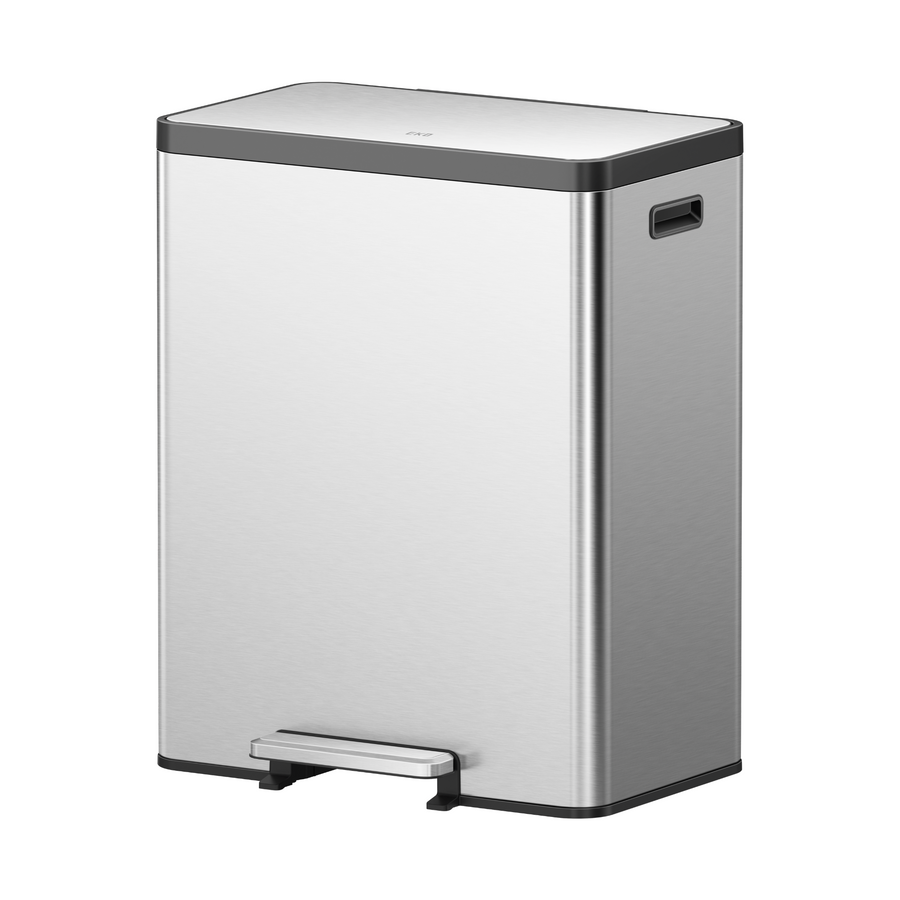
For most office and food-service applications, a two-stream setup (recyclables and general waste, or recyclables and compost) covers the bulk of what's generated day to day. Dual-compartment cans in our catalog span a wide capacity range to match office and kitchen volume: EcoCasa II runs from 20+20L up to 36+24L, Edison covers 30+30L, Essential runs 30+30L, and EcoCasa Plus scales up to 40+40L for high-volume kitchens. Each compartment uses its own liner, so streams stay physically separated from the point of disposal through collection — no re-sorting required downstream.
Where a building runs a true three-stream program (recyclables, compost, landfill), pair a dual-compartment recycling can with a dedicated compost bin such as the Puro (3L or 5L) at food-prep and dining areas, rather than trying to force three streams into a two-compartment unit.
Signage and Labeling That Actually Works
Compartment shape alone doesn't guarantee correct sorting — labeling has to be legible at a glance and consistent across every station in the building. A few practices that measurably reduce contamination:
- Use consistent color coding across every station (the same color always means the same stream), not different colors per floor or department.
- Label with both text and simple icons — text alone is skipped by people moving quickly, and icons alone are ambiguous for less common materials.
- List a short "yes/no" example set directly on or above the bin (paper and cardboard: yes; food-soiled containers: no) rather than a generic recycling symbol.
- Place recycling and general waste compartments physically adjacent, never in separate locations, so there's no extra decision about which bin to walk to.
Office vs Food Service Recycling Considerations
Office recycling streams are dominated by paper, cardboard, and single-stream containers from break rooms — a smaller dual-compartment can (20+20L to 30+30L) placed at print stations and break rooms usually covers the volume. Food service recycling has to account for higher volume and wetter waste, so the larger dual-compartment options (36+24L up to 40+40L) and a separate compost stream for food scraps are worth the added footprint. Placement also differs: office stations work best centralized near high-traffic zones, while food-service stations need one per prep or plating station to prevent staff from defaulting to the nearest general trash can under time pressure.
Liner strategy differs between the two settings as well. Office recycling compartments generally use a lighter-gauge liner since paper and light packaging don't stress the bag the way wet waste does, while food-service compartments — on either the recycling or general-waste side — need a liner rated for wet weight and puncture resistance from broken glass, cans, or bone. Standardizing liner weight by setting rather than by compartment size avoids the common failure mode of an office-grade bag splitting under commercial kitchen volume.
| Product family | Compartment split | Best fit |
|---|---|---|
| EcoCasa II | 20L+20L | Office break rooms, small kitchens |
| Edison | 30L+30L | Mid-size kitchens, cafeterias |
| Essential | 30L+30L | General office and retail back-of-house |
| EcoCasa II (large) | 36L+24L | High-traffic kitchens |
| EcoCasa Plus | 40L+40L | High-volume commercial kitchens |
Placement and Servicing Cadence
Where a recycling station sits matters as much as its compartment configuration. Stations placed more than a short walk from where waste is actually generated see lower participation, regardless of how well they're labeled — convenience beats intention every time. In offices, that means placing stations at natural gathering points (print areas, break rooms, kitchenettes) rather than only at building exits or hallway ends. In food service, it means a station at every prep and plating position rather than a single central station serving the whole kitchen, since staff under time pressure will default to whatever bin is closest.
Servicing cadence should also be set per compartment rather than per can. Recyclables in an office setting typically fill more slowly than general waste and can run on a longer collection cycle, while food-service compost and recycling compartments often fill at rates close to the general waste side and need matching servicing frequency. Setting a single blended schedule across both compartments usually means one side is serviced too often and the other not often enough.
Compliance Basics
Many municipalities now mandate commercial recycling and, increasingly, organics separation for food-service operations above a certain size — requirements vary by city and county, so confirm local ordinances before finalizing a program rather than assuming a two-stream setup is sufficient. Some jurisdictions also require specific signage language or icon sets for compliance audits, which is worth checking before finalizing custom labeling. Whatever the local requirement, the equipment principle stays the same: make the correct sorting choice physically easier than the wrong one. Browse dual-compartment options across our full range, pair them with correctly sized liners for each compartment, and request a quote if you're rolling out a multi-floor or multi-location program.