

On this page
Capacity is the single most common sizing error in commercial waste receptacle procurement — buyers either standardize on one size for an entire building, or they guess based on a can's footprint rather than its liter rating. This guide covers the liter-to-gallon math, the three capacity tiers used across our catalog, how to estimate bin counts from square footage and traffic, and how to match bag codes to the can sizes you land on.
Liters and Gallons: The Conversion Procurement Teams Need
One US gallon equals roughly 3.785 liters, so a rough rule of thumb is to divide liters by 3.8 to get gallons, or multiply gallons by 3.8 to get liters. A 50L can is close to 13.2 gallons; a 20-gallon can is roughly 76L. Because most commercial buyers spec by liter (matching bag manufacturer sizing) but budget and reference capacity by gallon (the more familiar US unit), it's worth converting both ways when comparing quotes or cutting purchase orders, since a supplier quoting "13 gallon" and one quoting "50L" may be describing the same can.
The Three Capacity Tiers
Commercial trash cans generally fall into three tiers, and each tier maps to a different use case.
Small — under 8 gallons / under 30L. Restroom sensor and step cans (Stella at 6L and 10L, Morandi at 10L, Astro at 10L), tabletop bins (Fandy at 1.5L and 2.2L), and compost bins (Puro at 3L and 5L) fall in this tier. These are sized for low-volume, frequently serviced areas — a single restroom stall, a vanity counter, a prep station.
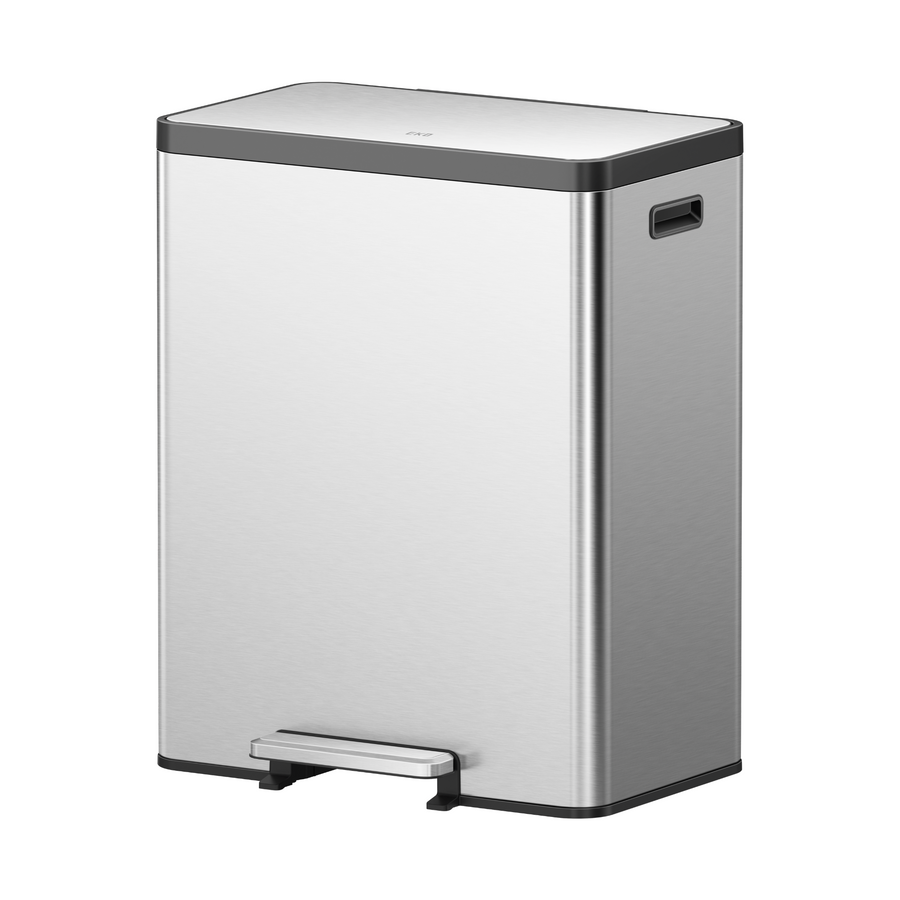
Mid — 8 to 16 gallons / 30L to 60L. This is the workhorse tier for kitchens, offices, and lobbies: Madison and Hudson step cans at 50L, Urban open-tops at 60L, and dual-compartment recycling cans like Edison (30+30L) and EcoCasa II (36+24L). Most single-station commercial waste needs fall here.
Large — 16 gallons+ / 60L+. Reserved for high-volume or infrequently-serviced areas: Urban open-tops at 80L, 90L, and 120L, Ecosmart and Mirage-X sensor cans at 80L, and Hudson step cans at 75L. These sizes reduce servicing frequency in outdoor areas, large kitchens, and busy lobbies.
How Many Bins Per Square Footage and Foot Traffic
There's no single formula that fits every facility, but these starting ratios hold up across most commercial layouts and can be adjusted after a week of observed fill rates:
- Restrooms: one small can (under 30L) per one to two fixtures.
- Open office floors: one mid-size can (30L-50L) per 150 to 250 square feet, or one per desk cluster of six to ten people, supplemented by centralized break-room stations.
- Kitchen lines: one mid-to-large step or recycling can per prep or plating station, sized to the shift's waste volume rather than the room's square footage.
- Lobbies and corridors: one large open-top can every 50 to 75 feet of high-traffic path, plus one at every entrance.
- Outdoor and parking areas: one large can (80L+) per entrance and per 40-60 parking spaces or equivalent pedestrian zone.
These ratios assume standard daily servicing. Facilities running reduced janitorial schedules should size up a tier rather than add more of the same size — fewer, larger cans usually beats more frequent servicing from a labor-cost standpoint.
Matching Bag Codes to Can Sizes
Once capacity is set, the liner has to match, or you'll see torn bags, overhang that snags on lids, or bags too small to tie off. Our trash bag lineup is coded A through Z by capacity range, and the table below maps common bag codes to the can sizes they're built for.
| Bag code | Rated capacity | Matches can size |
|---|---|---|
| Code A | 1.6 gal (3-6L) | Tabletop bins (Fandy) |
| Code B | 2.6 gal (7-10L) | Small sensor/step cans (Stella, Astro, Morandi) |
| Code C | 4 gal (10-15L) | Small step cans, 12L class |
| Code E | 9.5 gal (30.3-36L) | Compact kitchen or recycling compartments |
| Code F-1 | 8 gal slim (30.3L) | EcoCasa II 6L combo / narrow-body cans |
| Code F | 13 gal (50L) | Madison, Hudson, and Mirage-T 50L cans |
| Code J | 12.9 gal (45-49L) | 50L step and sensor cans (tighter fit) |
| Code Z | 12.5 gal (40-60L) | Mid-tier cans, including 60L open-tops |
| Code G | 21 gal (80L) | Urban 80L open-tops, EcoSmart 80L sensor cans |
Avoiding Under- and Oversizing
Undersized cans mean overflow, more frequent servicing trips, and bags that split under load — all of which cost more in labor over a year than the marginal price difference of the next capacity tier up. Oversized cans, on the other hand, waste floor space and encourage bags to sit half-full longer, which matters in food service areas where odor and pest control are concerns. When in doubt between two tiers for a given space, size up for outdoor and kitchen applications (where servicing is harder to increase) and size down for restrooms and offices (where frequent servicing is already routine).
Why Capacity Isn't the Only Number That Matters
Rated liter capacity tells you volume, but two cans with the same liter rating can behave differently in daily use depending on their footprint and opening size. A tall, narrow can holds the same volume as a short, wide one but empties faster in practice because a narrower opening restricts bulky items and encourages more frequent compacting by staff, which can actually shorten servicing intervals despite the identical capacity number. When comparing two products at the same liter rating, check the footprint dimensions and opening size against the space constraints of the install location — a tight restroom stall or a narrow kitchen aisle may rule out a wide-body can even at a capacity that would otherwise fit the traffic profile.
It's also worth separating rated capacity from practical fill capacity. Manufacturers rate cans at full volume to the rim, but most janitorial programs service a can once it's roughly 75 to 80 percent full to avoid overflow and make bag removal easier. Budget for that margin when converting a calculated waste volume into a capacity spec — a space generating an estimated 40L of daily waste is better served by a 50L can than a 40L can rated exactly to that volume.
Review the full range of capacities across available product families before finalizing a purchase order, and reach out through our quote request form if you need help reconciling bin counts against a floor plan.