

On this page
Sensor, step, and open-top are the three lid mechanisms used across nearly every commercial trash can family, and each one trades off hygiene, throughput, and maintenance differently. Picking the wrong mechanism for a space is a common and avoidable cost — either you're servicing batteries in a low-traffic hallway that didn't need them, or you're asking staff to touch a lid in a restroom that should have gone touchless. This guide breaks down what each mechanism actually costs and where it earns its keep.
Sensor Cans: Touchless Hygiene at a Cost
Sensor cans use a motion detector to open the lid automatically, so no one touches the can to dispose of waste. This is the strongest hygiene profile of the three mechanisms and the reason sensor cans dominate restroom and high-touch-area specifications. Product families like Mirage-T, Mirage-X, Phantom-T, Nova, Astro, Stella, and Bono cover sizes from 6L up to 80L, so the format scales from a single-stall restroom can up to a large kitchen unit.
The tradeoff is battery logistics. Sensor cans run on replaceable batteries (commonly D-cell), and a facility running dozens of sensor cans needs a battery replacement schedule built into the janitorial routine — a dead sensor effectively turns the can into a closed box until serviced. Sensor mechanisms also have more moving parts than a step or open-top lid, so they carry a higher unit cost and a small but real maintenance burden beyond just liner changes.
Step Cans: The Commercial Workhorse
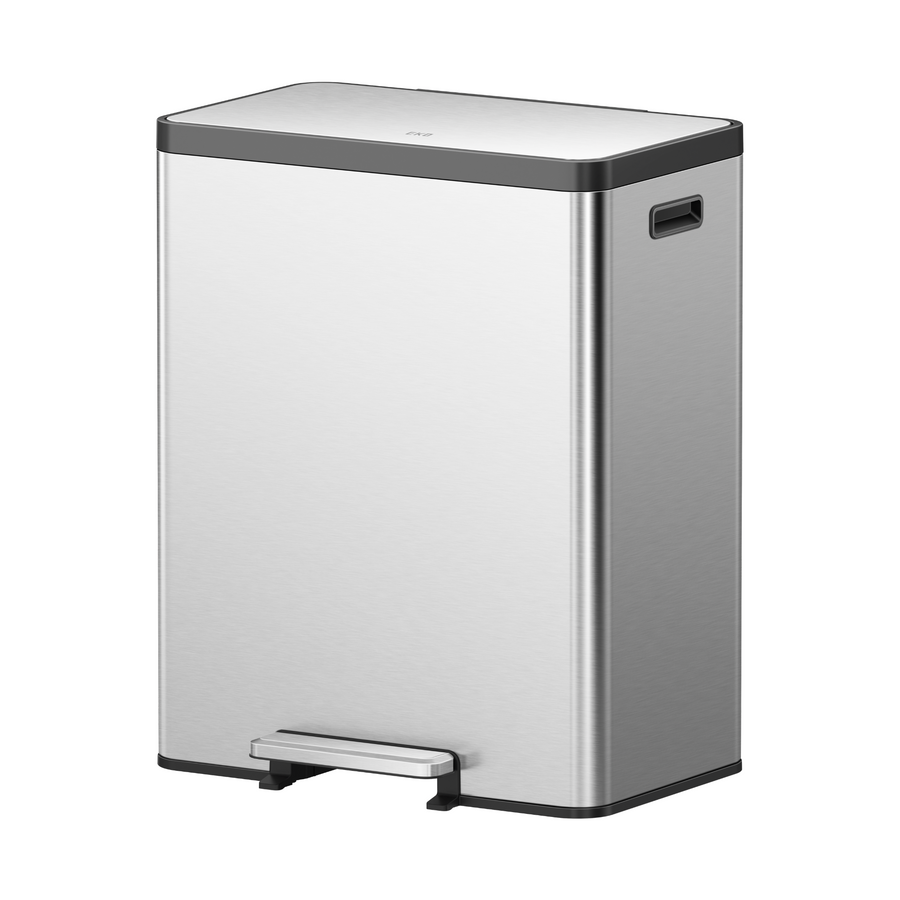
Step cans use a foot pedal to lift the lid, which keeps hands free without the cost or battery dependency of a sensor. This is the most common mechanism across our catalog — Madison, Hudson, Maxwell, and EcoCasa II collectively cover the widest capacity range of any single mechanism type, from 5L bathroom cans up to 75L kitchen units. Step cans hold up well under sustained daily use because the pedal mechanism is simple and mechanical, with no electronics to fail.
The hygiene profile sits between sensor and open-top: hands don't touch the lid, but the pedal and hinge do see repeated foot contact and require the same cleaning attention as any other high-touch surface. Step cans are the default recommendation for kitchens, offices, and general common areas where full-sensor coverage isn't in the budget but hands-free operation is still preferred.
Open Top Cans: Maximum Throughput, Minimum Maintenance
Open-top cans have no lid mechanism at all — waste goes directly into the liner. This makes them the fastest option for high-traffic disposal (no pedal to press, no sensor to wait on) and the lowest-maintenance option, since there's nothing mechanical to break. The Urban and Eternal families use this format at scale, from 56L up through 120L, and it's the standard choice for outdoor areas, lobbies, and high-volume food service lines where speed matters more than concealment.
The obvious tradeoff is that contents are visible and odor isn't contained the way a lidded can contains it, which is why open-top cans are rarely specified for restrooms or enclosed office areas but are the right call outdoors and in back-of-house food service.
| Mechanism | Hygiene | Throughput | Maintenance | Battery logistics |
|---|---|---|---|---|
| Sensor | Highest — fully touchless | Moderate (brief detection delay) | Highest — electronics + battery | Required — D-cell replacement schedule |
| Step | High — hands-free via pedal | High | Low — mechanical pedal only | None |
| Open top | Lowest — contents exposed | Highest — no lid delay | Lowest — no moving parts | None |
Total Cost Considerations Beyond the Unit Price
Purchase price alone understates the real cost difference between mechanisms. Sensor cans carry the highest unit cost up front, plus a recurring battery expense and the labor cost of a technician checking and swapping batteries on a schedule — a real but often overlooked operating cost that should be budgeted alongside liners and bags rather than treated as a one-time equipment purchase. Step cans have the lowest ongoing cost of the three since the only wear part is the pedal mechanism and hinge, both of which are simple and inexpensive to service if they eventually fail. Open-top cans have effectively zero mechanical cost but can generate higher replacement-liner spend in high-visibility areas, since exposed contents get bagged and swapped more conservatively (before the can is technically full) to keep the area presentable.
Servicing Frequency and Staffing Impact
Mechanism choice also interacts with how your janitorial staff moves through a route. Sensor cans slow down a servicing pass slightly, since staff wait a beat for the lid to cycle open and closed rather than stepping and moving on immediately. Step cans are the fastest to service in a walking route because the pedal action is instant and doesn't require standing in place. Open-top cans are fastest of all for a quick visual check (staff can assess fill level without opening anything), which matters on high-frequency lobby and outdoor routes where dozens of cans get checked per shift. None of these differences are large per can, but they compound across a property with fifty or a hundred receptacles serviced daily.
Choosing by Zone
In practice, most commercial properties run all three mechanisms in different zones rather than picking one for the entire building. Restrooms and high-touch clinical or hospitality areas justify the sensor premium; kitchens, offices, and general common areas run efficiently on step cans; and outdoor areas, loading zones, and high-volume food service lines are best served by open-top. If you're specifying a full property, our complete product range lets you filter by mechanism and capacity together, and our quote request form can help reconcile mechanism choice against your janitorial staffing model before you commit to a battery-dependent rollout.